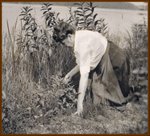
 The bees LOVE these! there were 10 or so swarming around within arm's length when I shot this. sorry kids, I'm not an entymologist nor horticulturist, so I can't tell you much more...
Showing posts with label Wildlife. Show all posts
Showing posts with label Wildlife. Show all posts
Monday, August 10, 2009


Friday, May 15, 2009
Fierce Defenders of Territory
As I was walking through the arbor in the garden this week, two male Baltimore orioles flew through the arbor and landed in a shrub in the garden border, fighting verbally and physically. From this I deduce that the garden is included in a mated oriole's territory. I have heard their song but this is the first time I saw an oriole this year.
Thursday, April 9, 2009
Spotted Salamander

Here's a very camera shy spotted salamander, Ambystoma maculatum, found near a vernal pool. These are believed to be able to live 20 to 30 years.
Photo taken 4/9/09
Wednesday, April 8, 2009
Redback Salamander

The redback salamander, Plethodon cinereus, may be found at the Gene Stratton-Porter State Historic Site in abundance. According to one website, they are the most common vertebrate in most woodland areas.
An immature dogtooth violet leaf, Erythronium americanum, is immediately to the right.
Photo taken 4/8/09.
Thursday, April 24, 2008
Tragedy by the garden shed door
Under the eaves by the front door of the Garden Shed, I've been watching a robin build a messy nest. 
Whoops! What happened? Was she a klutzy mom? Did a predator get into the nest? But then why wasn't the egg consumed? Someone suggested maybe a cowbird replaced one of her eggs. I'm going to have to keep watching.


Whoops! What happened? Was she a klutzy mom? Did a predator get into the nest? But then why wasn't the egg consumed? Someone suggested maybe a cowbird replaced one of her eggs. I'm going to have to keep watching.

Friday, July 13, 2007
Eacles Imperialis or Yellow Emporer
I was sitting on the bench in front of the Visitor's Center yesterday talking to Ed, the site naturalist, when his eyes got big and he pointed behind me. Here is what he saw. Note the eggs she laid on the doorframe. She left but we are still watching the eggs.

While it is an unusual moth for northern Indiana, what made this especially interesting is that Gene's best-selling book, A Girl of the Limberlost, centered on a young girl's search for this moth and...

Gene documented in words and photos the life cycle of what she called the Yellow Emperor in Moths of the Limberlost.

Here is a close shot of its head.

Look at the image on the back of the head. Doesn't it look like an angry face?

Tuesday, April 24, 2007
Woody, my co-worker
 Last winter a pair of pileated woodpeckers took up residence in a large beech tree near the Carriage House (the Visitors Center). About once a week a visitor spots this large bird and excitedly reports it to the naturalist. Note the rather large cavity he excavated on the left side of the limb.
Their drumming keeps me company as I work in the garden. It is a thrill to work along side such a gorgeous bird.
Watch for more photos as we try to get a good shot of this funny looking creature.
Subscribe to:
Posts (Atom)